
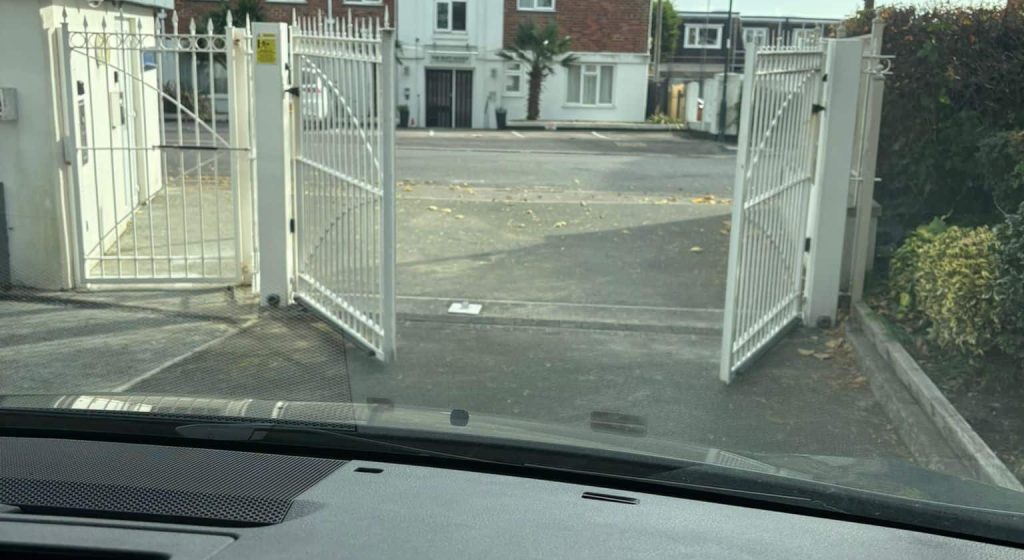
New Safety‑Edges Fitted Under Gate Leaves to Address Reducing Gap
At a residential block of flats in Bournemouth, the automatic entrance gates were found to pose a reducing gap hazard underneath the leaves. To mitigate this risk, we supplied and installed two safety‑edges on the bottom of each gate leaf — one on each side — making a total of four safety‑edges.
To facilitate the cable routing for the edges, we engaged a ground‑worker to remove block pavers and create a duct/trench beneath the surface so that cabling could run safely and discreetly under the ground. A metal plate, powder‑coated and welded to each gate leaf by a fabricator, provided a sturdy mounting base for the safety edges. We then completed the installation, tested and commissioned the safety devices, and confirmed the gates now meet enhanced safety requirements.
Why the Work Was Needed
Over time, the movement of the leaves and settling of the paving had resulted in the clear gap under the leaves reducing — potentially creating a crush/pinch hazard for users, especially children, pets or mobility users. According to guidance from the Gate Safe charity, such contact hazards beneath gate leaves are a recognised risk and should be addressed via safety edges, photocells and other protection.


The Works We Carried Out
- Arranged a ground‑worker to remove block pavers and create a cable route under the entrance zone.
- Supplied and arranged a fabricator to provide and weld a custom metal powder‑coated mounting plate on each gate leaf to allow solid fixing of the safety edges.
- Fitted the safety‑edges to the bottom of each gate leaf, mounted on the welded plate.
- Routed the cabling below ground in protective conduit/trunking, reconnecting to the gate automation controller and ensuring weather‑ingress protection.
- Performed commissioning and testing: verified that when the gate leaf moves and any object contacts the edge strip, the gate stops and/or reverses appropriately.
- Inspected the gap under the gate leaves, verified that the hazard gap no longer exists (or is within safe limits) and documented the installation for the client’s records.
Safety Standards & Compliance
It’s worth noting that powered gates in the UK are classed as machinery under the Health & Safety Executive (HSE) regulations, which means they must meet the requirements of the BS EN 12453 standard and associated tests such as force‑limitation and obstruction detection.
In particular:
- A contact hazard exists when a gate leaf reduces the gap to beneath 500 mm from a fixed object.
- Safety edges (also called pressure/contact edges) are recognised as critical protection devices where crushing or shearing zones may occur.
- For owners/managers of such gates (especially in communal residential settings) the legal duty is to ensure the system is safe, maintained and risk‑assessed.
In this instance, by installing safety edges correctly and routing cabling properly, we have significantly reduced the risk of contact injury from the gate leaves and improved compliance for the client.
- The gap beneath the gate leaves has been restored to safe dimensions, reducing the risk of entrapment or injury.
- The addition of safety edges means that if any person, limb or object makes contact with the underside of a leaf during movement, the gate will now respond (stop/reverse) rather than continuing.
- The work was completed with minimal disruption to residents—block pavers were removed and reinstated neatly, and the safety edges were mounted out of commonplace view.
- The client’s liability is reduced through proactive improvement of safety features, and they now have documentation of the modification for future inspection/maintenance.
If you manage a block of flats, a gated community or any property with automated gates and you’re concerned about reducing gap clearance, missing safety edges, or overall gate safety compliance, contact us at EAC Fire & Security. We can perform a full gate safety survey, risk‑assessment, and provide bespoke solutions (e.g., safety edges, photocells, control upgrades) to bring your system up to best‑practice standards.


