
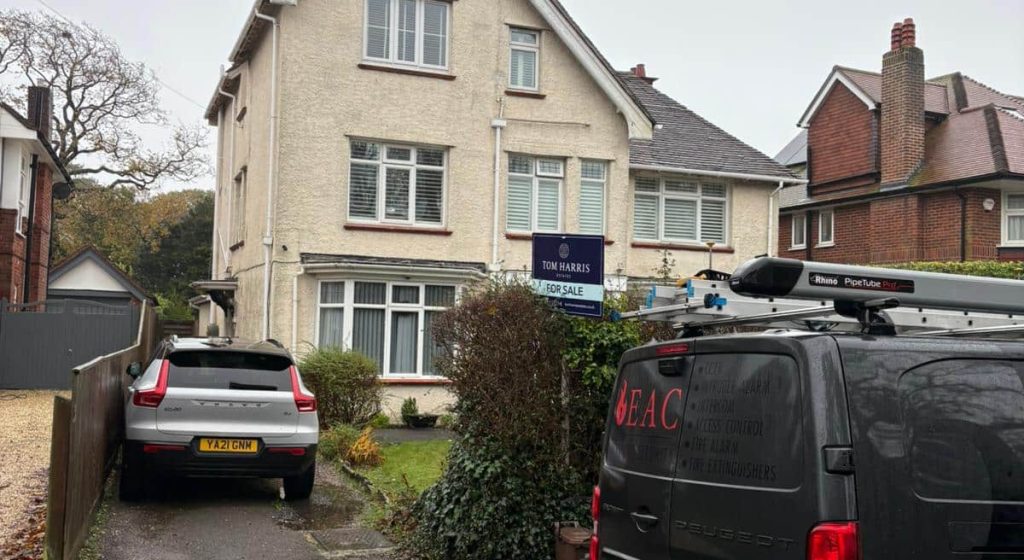
New Emergency Lighting and Grade D / Category L4 Fire Alarm System Installed
After a fire-risk assessment at a converted block of flats in Westbourne, the building owner commissioned us to upgrade the fire-safety provisions in the communal and escape-route areas. The upgrade included:
- Supply and installation of new emergency lighting throughout shared corridors and stairwells.
- Installation of a fire detection & alarm system: mains-powered smoke alarms (Grade D) configured under a Category L4 coverage — covering escape routes and communal circulation spaces only.
What We Did – Scope of Work
- Ran live cabling to each light fitting to power the new emergency luminaires, ensuring compliance with wiring standards.
- Fitted round emergency-light fittings with internal sensors (e.g. microwave/presence or fail-safe switching) at key communal zones and escape routes, to improve visibility during power failure or night-time evacuation.
- Installed mains-powered optical smoke alarms on each level (circulation areas / stair-wells) linked together for simultaneous alerting.
- Configured the system as a Category L4 fire-alarm: detectors cover corridors / stair-wells / escape routes but not individual flats. This is intended to provide modest life-safety protection where occupants rely on communal escape routes.
- Commissioned and tested the entire system: checked alarm operation, battery/back-up supply, emergency-light activation on loss of mains, and door-release / escape functionality.


Why This Specification Was Chosen
- Category L4 is commonly used for blocks of flats or low-risk residential buildings where automatic detection is required along escape routes and communal circulation spaces only — e.g. corridors, hallways, stair-wells — rather than full detection coverage of every room.
- A Grade D system (within the domestic/ residential standard context) typically means mains-powered smoke alarms (with standby power) are installed — sufficient in many shared-housing or converted-flat scenarios when installed correctly.
- Adding emergency lighting across communal escape routes significantly improves safety. According to guidance, blocks of flats should have emergency or escape-route lighting — especially for stairways, corridors, and any escape path — so occupants can evacuate safely if normal lighting fails.
Outcome & Client Benefits
- The building now has reliable fire detection in all common escape routes and stairwells — giving early warning if smoke is detected, and alerting all occupants simultaneously.
- Emergency lighting ensures that stair-wells, corridors and escape routes remain illuminated during power loss — a crucial aid for safe evacuation, especially after dark or if electricity fails.
- The installation meets accepted standard practices and offers legal defensibility in fire-safety duty of care for landlords or responsible persons under fire regulations.
- The upgrade brings added value to the property, potentially improving safety rating and tenant peace-of-mind — a strong selling point for converted flats.
Recommendations & Aftercare
- Perform monthly “flick-test” checks on emergency lighting (turn off mains for a short time to ensure lights switch on) and note results in a log book.
- Schedule a full duration test annually for emergency lighting, and test smoke alarms regularly per manufacturer and standard-recommendation intervals.
- Retain documentation and commissioning certificates, especially where flats are rented — this will support safety audits, inspections or regulatory compliance.
- If building use or occupancy changes (e.g. flats converted, bedrooms added, more residents), consider re-assessing fire-alarm coverage — L4 may need upgrading (to L3 or higher) if risk profile increases.


