
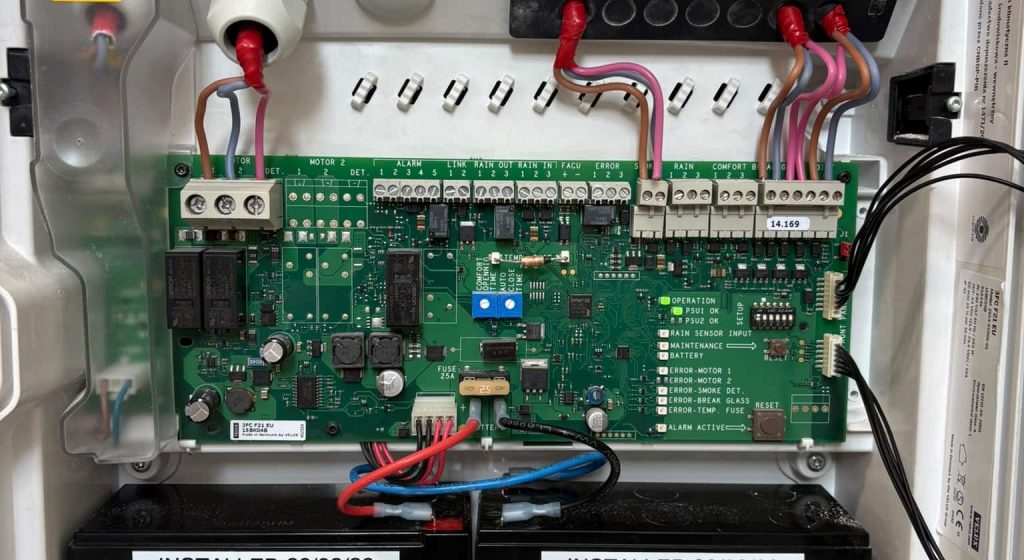
EAC Fire & Security recently completed extensive remedial works to an Automatic Opening Vent (AOV) smoke ventilation system at a residential block of flats in Bournemouth, Dorset.
During a routine AOV service, our engineers identified several non-conformities affecting the existing smoke ventilation installation, including unsuitable cabling, inadequate fire detection arrangements and an incorrectly configured electrical supply.
Following our inspection, we carried out the necessary repairs and upgrades to bring the system up to the required standard, helping ensure the building’s communal stairwell has a reliable automatic smoke ventilation system in the event of a fire.
Why Was the Work Needed?
Automatic Opening Vent (AOV) systems play an important role in fire safety within residential blocks of flats and other multi-storey buildings.
These systems are designed to automatically open smoke vents when activated, helping remove smoke from communal escape routes such as stairwells and corridors.
During a scheduled AOV service and inspection at this Bournemouth property, we identified several issues requiring attention.
The existing installation had a number of non-conformities:
- Non-fire-resistant cabling: The existing actuator cabling required replacement with suitable fire-resistant cable.
- No automatic smoke detection trigger: The AOV system was not connected to a fire alarm trigger and had no independent smoke detector.
- Cabling support improvements: The wiring required suitable containment and fire-resistant supports to reduce the risk of premature collapse during a fire.
- Additional manual activation: A manual call point was required to provide a means of operating the smoke ventilation system.
- Electrical supply: The AOV was sharing a mains supply with the building’s socket circuits rather than having a dedicated feed.
These issues meant that the system required remedial work to provide the intended level of fire safety protection.
Works Completed


1. Fire-Resistant Cabling Replacement
Our engineers removed and renewed the existing cabling supplying the AOV actuators.
The replacement wiring was installed using fire-resistant cable, helping maintain the integrity of the connections under fire conditions for the required period.
New trunking was installed throughout the communal stairwell, running up to the top floor.
We also fitted metal D-Line cable supports to provide additional protection against premature cable collapse in the event of a fire.
2. Automatic Smoke Detection Installation
One of the main issues identified during the service was the lack of an automatic activation trigger.
The existing AOV system was not connected to the building’s fire alarm system and did not have a dedicated smoke detector to activate the vents.
To rectify this, we installed a new smoke detector connected to the smoke ventilation system.
This allows the AOV to receive an automatic activation signal when smoke is detected, removing the need to rely solely on someone manually operating the system.
3. Manual AOV Call Point Installation
Alongside the automatic smoke detector, we installed a new manual call point for the smoke ventilation system.
This provides an additional method of activating the AOV when required.
Manual activation points are an important part of many smoke ventilation installations, providing an alternative means of operation when needed.
4. Dedicated Electrical Supply
During our inspection, we discovered that the existing AOV mains supply was connected to the same electrical circuit as the building’s sockets.
To address this issue, our engineers installed a new dedicated electrical feed from the distribution board to supply the smoke ventilation system.
Separating the AOV supply from general socket circuits helps reduce the likelihood of unrelated electrical faults or circuit interruptions affecting the system.
5. Final System Checks
Following the installation and remedial works, the AOV system was checked as part of the completion process.
The work addressed the non-conformities identified during the original service, including the cabling, automatic detection, manual activation and electrical supply arrangements.
The Outcome
The communal smoke ventilation system at this Bournemouth residential building has now been upgraded to address the identified compliance issues.
The completed works included:
- New fire-resistant cabling to the AOV actuators.
- Trunking and metal cable supports installed throughout the stairwell.
- An automatic smoke detector installed for system activation.
- A manual AOV call point installed.
- A dedicated mains electrical supply installed from the distribution board.
- Remedial work completed to address the identified non-conformities.
The building now benefits from an upgraded automatic smoke ventilation system, designed to operate when smoke is detected and help protect communal escape routes.
AOV Servicing, Repairs & Smoke Ventilation Systems in Bournemouth
At EAC Fire & Security, we provide professional AOV servicing, smoke ventilation system repairs, maintenance and installations throughout Bournemouth, Poole, Christchurch and the surrounding Dorset areas.
Whether your building requires a routine AOV inspection, fault diagnosis, replacement components or remedial work following a fire safety assessment, our experienced engineers can help.
We also provide a range of related fire safety services, including fire alarm installations, fire alarm servicing and fire and security maintenance and repairs.
Explore our AOV and smoke ventilation services or learn more about our fire and security services in Bournemouth.
Need an AOV inspection or smoke ventilation system repair?
Contact EAC Fire & Security to arrange an inspection or discuss your building’s fire safety requirements.


